



“You already know how to do the hardest part of research,” Dr. Joseph Zabner told the room of Internal Medicine Residents during noon conference earlier this week. The Director of the Division of Pulmonary, Critical Care, and Occupational Medicine explained that the ingenuity that underlies a good testable hypothesis is what is most difficult to teach. And every day, with every diagnosis in every clinic and ward they staff, each resident is continually practicing and honing their insights. “Everything else in research,” Dr. Zabner said, “is just methodology.”
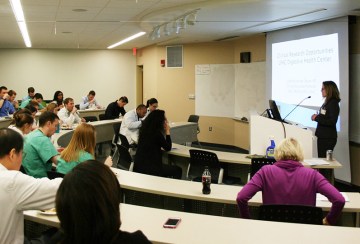

Drs. Gehlbach and Zubairu decided to expose the residents to as many of the available options in one sitting, the noon conference. Dr. Zabner and about ten other faculty members representing each division took the hour to introduce residents to the wide array of research in the department. Each subspecialty representative quickly ran through the basic, clinical, and translational options that might align with residents’ interests. Dr. Barry London, Division Director of Cardiovascular Medicine, put the choice facing the residents succinctly: “Make sure you do what you enjoy.”
Residents have plenty to choose from. Department Chair and Fraternal Order of Eagles Diabetes Research Center Director Dr. Dale Abel compared reading the long list of faculty available in the center to browsing through a candy store. Dr. Dan Berg, director of the fellowship program in the Division of Hematology, Oncology, and Blood & Marrow Transplantation, made it clear that opportunities to work on clinical trials at every stage were just as abundant as opportunities to work in basic research labs.


Other faculty members presenting included Dr. Diana Jalal, Division of Nephrology and Hypertension, citing her research into the intersection of cardiovascular disease and chronic kidney disease, as well as Division Director Dr. Chou-Long Huang’s research in soluble klotho mechanisms. Dr. Judith Assouline-Dayan from the Division of Gastroenterology and Hepatology pointed out that resident-assisted research into a question resulted in a recently submitted abstract to an upcoming national meeting. Immunology Division Director Dr. Scott Vogelgesang pointed out that if learning more about writing or editing was of interest, his division is the current home of the Journal of Allergy and Clinical Immunology.
The noon hour ended quickly, but each presenter made it clear that he or she would be available for questions or advice. Reflecting on the presentations, Dr. Zubairu said, “I was delighted by the immense response and support we received from every division to help organize this event. The talks were well received with positive feedback from residents and faculty.” Future events may involve more opportunities for one-on-one discussions between faculty and residents or a panel of former residents describing their experiences.


